
TECHNICAL OVERVIEW
Purpose and operating principle
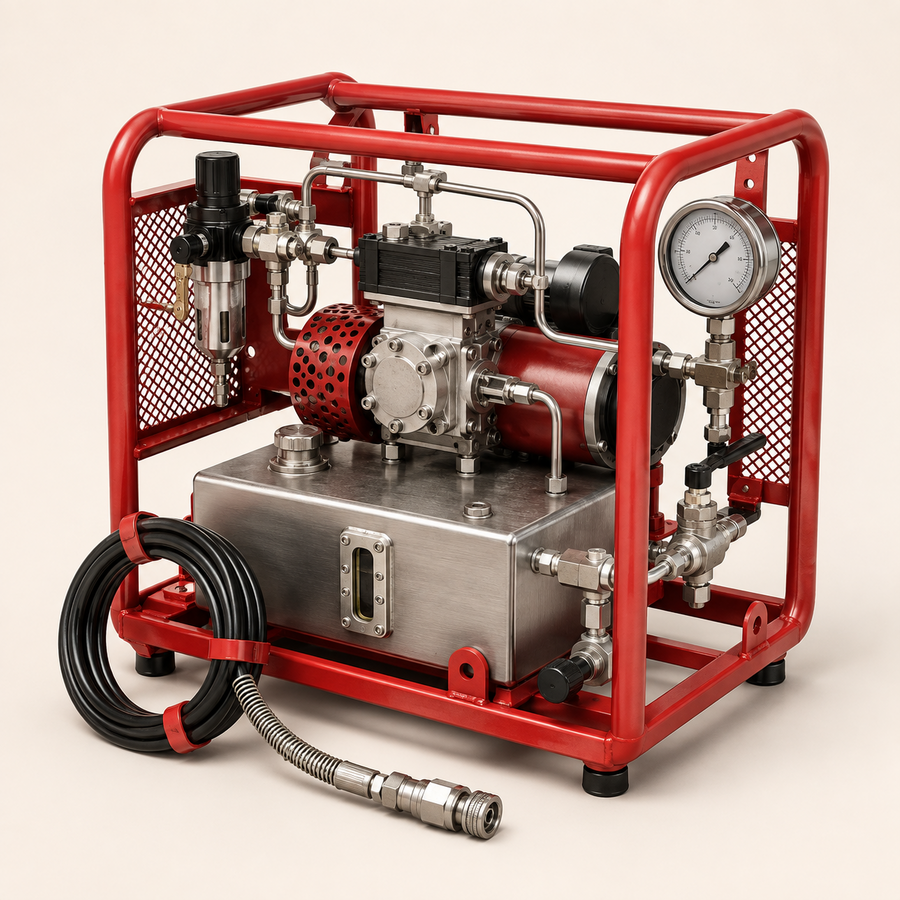
A hydrostatic pressure-test unit combines a pressure-generating pump with the controls, gauges, valves, reservoir and connections required to fill a test item, raise pressure in a controlled manner, hold the specified test pressure and safely release pressure. Packages are configured for the test medium, pressure envelope, fill volume, site conditions and recording requirements.
How it works
The test circuit is filled and vented before controlled pressurisation begins. A low-pressure/high-flow prefill pump may be used for larger volumes, followed by a high-pressure/low-flow pump for final test pressure. Isolation and non-return devices retain pressure while calibrated instruments monitor the hold period. A controlled bleed arrangement depressurises the circuit after acceptance or an approved abort condition.
Available configurations
- Compact portable test unit
- Protective case-mounted field unit
- Offshore stainless-steel frame package
- Skid-mounted reservoir and pump assembly
- High-pressure test package with guarded controls
- Dual-pump prefill and high-pressure test system
Main components
- Air-driven, manual, electric or engine-driven liquid pump selected for the duty
- Air filter, regulator and drive-pressure gauge where pneumatically driven
- Cycle-rate or speed-control valve and silencer where applicable
- Liquid reservoir, inlet filter and suction strainer
- High-pressure isolation and non-return valves
- Calibrated outlet-pressure gauge or transducer
- Pressure-limiting and controlled bleed devices
- Rated high-pressure hose, tubing, fittings, restraints and guards
- Optional chart recorder or digital data-acquisition system
Typical upstream applications
- Pressure testing of valves and wellhead equipment
- Piping, hose and pressure-vessel hydrotests
- Leak, proof and integrity testing
- Maintenance and commissioning support
- Relief-valve test benches
- Bolt tensioning, clamping and hydraulic-tool supply where approved